
Do You Need a Hi-Lift Jack Mount for Your Toyota Tacoma? Complete Off-Road Recovery Setup Guide (2005-2023)
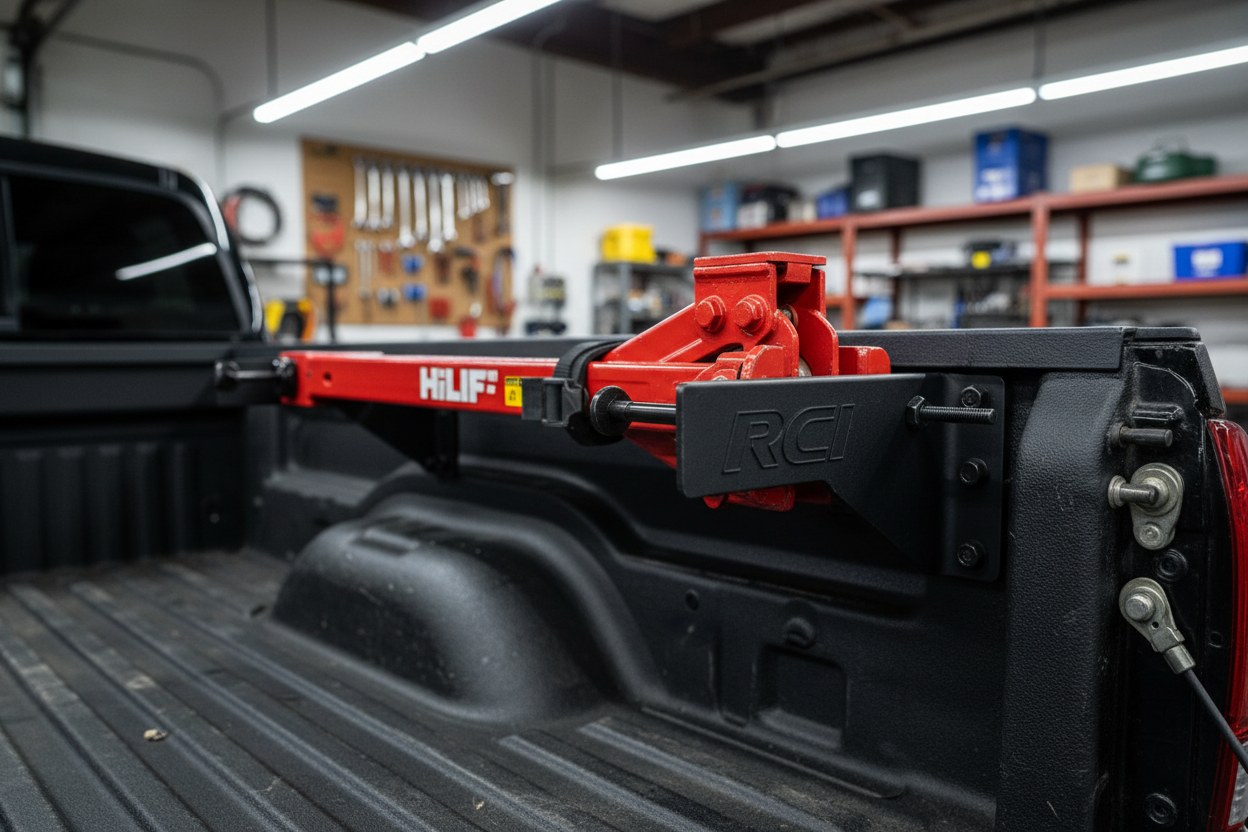
You've got the recovery boards. You've got the traction and the tow strap. But when it comes to a full-size Hi-Lift jack, most Tacoma owners end up wedging it behind the seat, bungee-cording it to a roll bar, or worse — leaving it home because there's nowhere good to put it.
That's a problem. A Hi-Lift is one of the most versatile recovery tools you can carry on the trail — it lifts, it winches, it spreads a stuck tire back onto traction boards. But a 48" or 60" steel jack rattling around loose in your bed or cab is a liability, not a tool. On rough trails it becomes a projectile; in your garage it's just in the way.
If you're running a 2nd or 3rd Gen Tacoma and you're serious about overlanding or backcountry recovery, the fix isn't a milk crate and a ratchet strap. It's a dedicated Hi-Lift jack mount that bolts to hardware you already have.
Why a Dedicated Hi-Lift Mount Matters
A loose Hi-Lift jack in the bed of a moving truck is a real safety issue on washboard roads, whoops, or steep descents. Beyond safety, a proper mount solves three practical problems:
- Cargo space. A 60" jack eats an entire side of your bed if it's just laid flat. Mounting it vertically or to a rack frees up room for coolers, recovery boards, and camp gear.
- Accessibility. When you're actually stuck, you don't want to unpack half your truck to reach the jack. A rail- or rack-mounted jack is grab-and-go.
- Rattling and wear. An unsecured jack bangs against your bed liner or truck bed for hundreds of miles of washboard, scratching paint and loosening its own hardware over time.
What to Look for in a Mount
Not all Hi-Lift mounts are created equal. Before you buy, check for:
- No-drill installation. A mount that bolts to factory bed rails or an existing rack means no holes in your bed, no rust points, and a straight resale value.
- Material and hardware. Look for powder-coated steel brackets with stainless hardware — trail dust and moisture will chew through anything less in a season or two.
- Fit to your existing gear. If you already run an RCI bed rack or roof rack, a mount designed for that rack keeps everything on one system instead of adding a second set of brackets to your bed rails.
Bed Rail, Bed Rack, or Roof Rack — Which Mount Fits Your Tacoma?
The right mounting location depends on what's already on your truck. Here's how the three most common setups compare:
| Mount Type | Best For | Fitment | Price |
|---|---|---|---|
| RCI Offroad Hi-Lift Mount | Toyota Tacoma (2005-2023) | Trucks with no rack — bolts straight to factory bed rails | 2005-2023 Tacoma (2nd & 3rd Gen) | $98.00 |
| RCI Offroad Bed Rack Hi-Lift Mount | Trucks already running an RCI bed rack | Universal — RCI bed racks (Tacoma & Tundra) | $71.00 |
| RCI Offroad Roof Rack Hi-Lift Mount | Trucks running an RCI roof rack that want the bed left open | Universal — RCI roof racks (Tacoma, 4Runner, Tundra, Sequoia, Land Cruiser) | $98.00 |
For most Tacoma owners without an existing rack, the bed-rail mount is the simplest entry point — it uses hardware your truck already has. If you've already invested in a bed rack or roof rack, the rack-specific mounts keep your jack on the same system and skip a second set of bed-rail brackets entirely.
The Fix: RCI Offroad Hi-Lift Mount for Tacoma
The RCI Offroad Hi-Lift Mount | Toyota Tacoma (2005-2023) is a bed-mounted jack bracket system built specifically for 2005-2023 Tacomas. It secures a Hi-Lift jack to either side of your truck bed using the factory OEM bed rails — no drilling, no cutting, no permanent modification.
Here's why it solves the problem outlined above:
- Eliminates the loose-jack rattle. The jack locks against the rail with a quick-release strap system, so it's secure over washboard and rock crawling alike.
- Keeps your recovery gear organized. Instead of taking up floor space in the bed, the jack sits flush against the rail — cargo space stays usable.
- Fits both generations. Because it mounts to the factory bed rail rather than a specific bumper or rack, it covers 2nd Gen (2005-2015) and 3rd Gen (2016-2023) Tacomas alike.
- Quick-access when you need it. No digging through the cab or unstacking gear — the jack is right where you can see it and reach it.
Complete the Setup: Winch Control Box Relocation
If you're running a 3rd Gen Tacoma (2016-2023) with an aftermarket winch, your recovery setup doesn't stop at the jack. Modern aftermarket bumpers leave limited room for a winch control box, and factory-mounted boxes often crowd out the winch itself or block airflow to your radiator.
The RCI Offroad Winch Control Box Relocation Bracket | Toyota Tacoma (2016-2023) relocates your winch control box to free up bumper real estate and accommodate a wider variety of winches — SuperWinch, Warn ZEON, or Warn EVO units — without compromise. Pair it with your Hi-Lift mount and you've got a complete, trail-ready recovery station instead of a pile of loose gear.
Frequently Asked Questions
Are Hi-Lift jacks safe to use for trail recovery?
Yes, when used correctly. Hi-Lift jacks are mechanically simple and extremely strong, but because they lift on a narrow base and a tall column, they carry more tip-over risk than a low-profile hydraulic jack. Always set the base plate on firm, level ground, keep bystanders clear of the lift path, and never work under a vehicle supported only by a Hi-Lift. A secure mount also improves safety indirectly — a jack that isn't rattling loose in your bed is a jack that's actually maintained and ready to use correctly when you need it.
Is a 48" or 60" Hi-Lift Jack better for a Tacoma?
For most Tacoma builds, a 48" jack is the more practical choice — it's lighter, easier to store, and still provides plenty of lift height for a stock-to-moderately-lifted truck. A 60" jack offers more reach for larger tires or deeper recovery situations (like lifting out of a rut), but it's heavier and bulkier to mount. Either length fits securely on the RCI Offroad Hi-Lift Mount, so the decision comes down to your tire size and how much extra bed real estate you're willing to give up.
What is the "3/4 rule" for Hi-Lift jack safety?
It's a widely cited trail-safety guideline: avoid running a Hi-Lift jack at its absolute maximum extension, and instead treat roughly the top quarter of the jack's travel as a no-go zone for stability. The idea is that a fully maxed-out jack has a higher center of gravity and less margin before it tips. Combine this with a full base plate on solid ground for the safest lift.
Who makes the best Hi-Lift Jack?
Hi-Lift Jack Co. is the original manufacturer and still the most trusted name in the segment, offering cast and forged versions in 42", 48", and 60" lengths. Whichever brand of jack you run, the mounting hardware matters just as much — a quality jack stored loose or improperly secured negates a lot of that reliability.
What's a good alternative if I don't want to run a full-size Hi-Lift?
Bottle jacks and off-road-rated hydraulic jacks are lighter and lower-profile, but they can't do double duty as a hand winch or spreader the way a Hi-Lift can, and most need a stable, flat surface that isn't always available on the trail. Many overlanders run both: a compact hydraulic jack for routine tire changes and a Hi-Lift, properly mounted, reserved for real recovery situations.
What's the difference between a hydraulic jack and a Hi-Lift jack?
A hydraulic jack (bottle or scissor style) lifts using fluid pressure and is fast and low-effort, but it typically has a fixed, narrow lift range and needs firm, flat ground under the vehicle's jack point. A Hi-Lift is a mechanical ratcheting jack that can lift from a huge range of heights, grab a bumper or rock slider instead of a factory jack point, and double as a hand-crank winch or clamp — which is exactly why it's a trail-recovery staple despite being bulkier to store.
Get Your Recovery Gear Off the Floor
A Hi-Lift jack only helps you on the trail if it's actually mounted, secured, and within reach — not buried under a cooler or rattling around in your bed. If you're running a 2005-2023 Toyota Tacoma without an existing rack, start with the RCI Offroad Hi-Lift Mount | Toyota Tacoma (2005-2023) — no drilling, bolts to your factory bed rails, and keeps your recovery gear exactly where you can grab it.
Already running an RCI bed rack or roof rack? Check out the RCI Offroad Bed Rack Hi-Lift Mount or RCI Offroad Roof Rack Hi-Lift Mount to keep everything on one system. Running an aftermarket winch on a 3rd Gen? Pair your jack mount with the RCI Offroad Winch Control Box Relocation Bracket | Toyota Tacoma (2016-2023) for a complete recovery setup.
Or browse the full Overland collection for rooftop tent mounts, awning brackets, and more recovery gear built for the long haul.