
Do You Need Rock Sliders for Your Toyota 4Runner? Complete Rocker Panel & Trail Protection Guide (2010-2024)
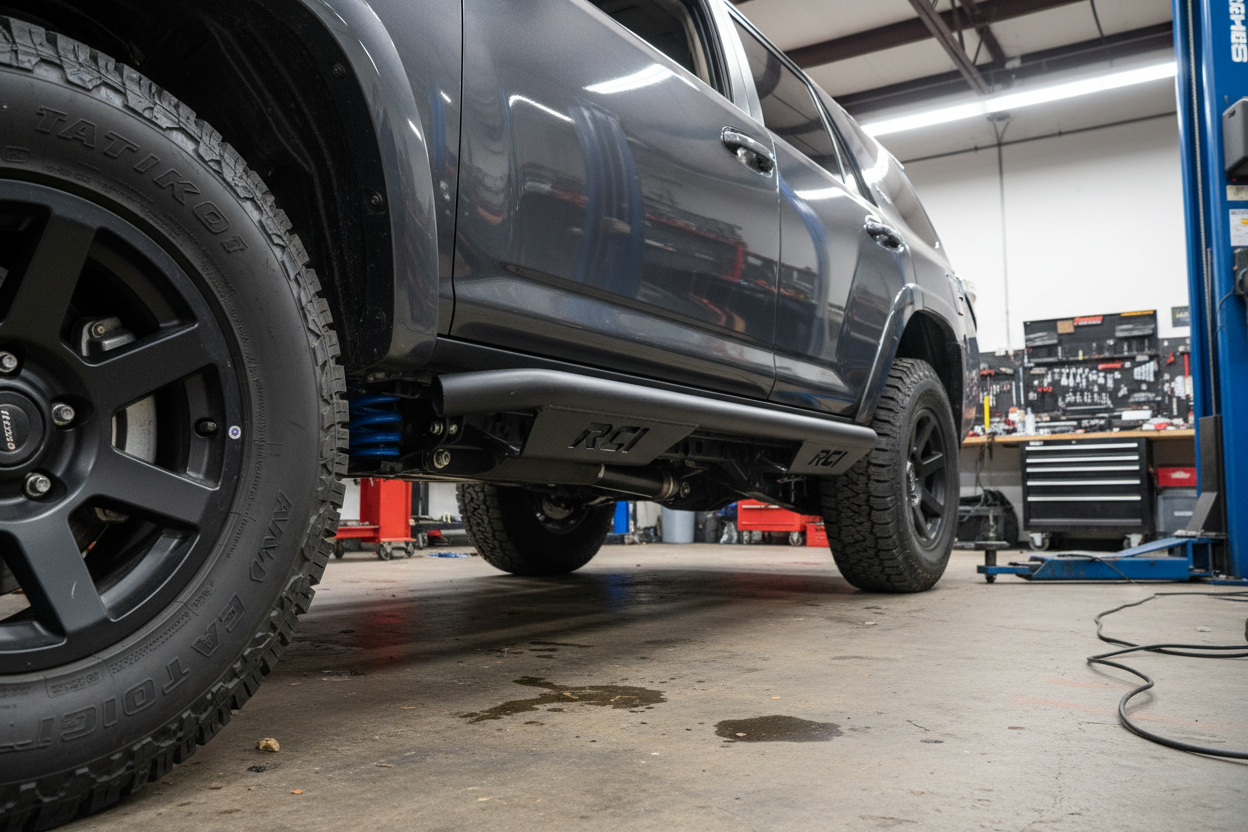
You're airing down at the trailhead, easing your 4Runner over a rutted shelf road, and you hear it before you feel it — that dull scrape of sheet metal finding rock. Or maybe it's simpler than that: a curb catches your rocker panel in a parking lot, and you're staring at a crease that wasn't there yesterday.
On a stock 2010–2024 Toyota 4Runner, the rocker panel is thin, unsupported, and sits exactly where obstacles hit first. Toyota didn't engineer it to take a hit — it's sheet metal doing a step's job, and it loses that fight every time. Once it's dented, you're looking at a body shop bill that can run into four figures, and a dent that never quite buffs out.
If you wheel your 4Runner on rocky trails, forest service roads, or technical off-camber terrain — or you just want real protection instead of the flimsy factory running boards — rock sliders solve this before it happens.
Why Rocker Panels Are Your 4Runner's Weak Point
The rocker panel runs the full length of the vehicle beneath the doors, and on the 4Runner it's closer to the ground and closer to obstacles than most drivers realize. A few reasons it's the first thing to get hurt on the trail:
- It's structural, not decorative. The rocker panel ties into the body and helps carry side-impact loads. Damage here isn't just cosmetic — it can compromise the panel's ability to do its job.
- It's the lowest point on either side of the truck. On articulated terrain, the rocker panel is often the first thing to contact a rock ledge, stump, or berm as the suspension flexes.
- Factory running boards make it worse, not better. Plastic or thin aluminum running boards aren't load-rated — they bend, tear off, or transfer the impact straight to the rocker panel anyway.
- Repairs are expensive and imperfect. Bodywork on a crushed rocker panel usually means panel replacement, paint matching, and a bill insurance often won't fully cover for off-road damage.
What Rock Sliders Actually Do (And What They Don't)
Rock sliders aren't running boards with a tougher name. They're a structural bolt-on tube or plate system that mounts directly to the frame and does two jobs at once:
- They absorb and deflect impact before it reaches the body, letting the vehicle "slide" across an obstacle instead of hanging up on it.
- They double as a step for climbing in, loading roof racks, or reaching gear — without sacrificing protection to get it.
- Some are rated as jack points, giving you a solid lift location on the trail where factory pinch welds won't hold.
The distinction matters: side steps and running boards are built for entry and looks. Rock sliders are built to take a hit and keep your rocker panel — and your frame — intact.
Bolt-On vs. Frame-Mounted: What to Look for Before You Buy
Not all rock sliders are engineered the same way, and the mounting method is what separates real protection from an expensive accessory. A few things worth checking before you buy a set for your 4Runner:
- Mounting style. Look for a full frame support mounting plate that spreads impact load across multiple bolt locations, not a slider that only bolts to a couple of points on the body.
- Tube material. Heavier-wall square tube resists bending better than thin round tube — this is the difference between a slider that shrugs off a hit and one that folds.
- Finish. A powder-coated or bare-metal-for-paint finish holds up to trail abuse better than a coating that chips on first contact.
- No-drill installation. A slider engineered to line up with existing frame holes means a bolt-on install with hand tools — no modifying your 4Runner to add protection to it.
Full Sliders vs. Low-Pro Rock Rails — Comparison at a Glance
| Feature | RCI Offroad Rock Sliders | Toyota 4Runner (2010-2024) | RCI Offroad Low-Pro Rock Rails | Toyota 4Runner (2010-2024) |
|---|---|---|
| Mounting | Full frame support mounting plate, multi-bolt | Bolt-on to existing frame locations, no drilling |
| Main tube | Heavy-duty tube, step-height profile | 2" square tube, low-profile |
| Best for | Regular rock crawling, needs a real step | Frame protection with a finished, streamlined look |
| Finish options | Bare material or satin black powder coat | Satin black powder coat |
| Starting price | $898.00 | $808.00 |
The Fix: RCI Offroad Rock Sliders for the 2010–2024 4Runner
Both options below are purpose-built for the 4th and 5th generation 4Runner (2010–2024) and mount using the frame's existing bolt locations — no cutting, no drilling.
RCI Offroad Rock Sliders | Toyota 4Runner (2010-2024)
The RCI Offroad Rock Sliders | Toyota 4Runner (2010-2024) use a full frame support mounting plate that spreads impact loads across multiple bolt locations, eliminating the stress concentration that crushes an unprotected rocker panel. That's the exact failure mode described above — a factory rocker panel absorbing a hit it was never built to take. These sliders take that hit instead, and they're rigid enough to double as a real step for entry, exit, and reaching your roof rack.
- Engineered specifically for both 4th-gen (2010–2013) and 5th-gen (2014–2024) 4Runner models
- Fits all cab and bed configurations
- Available bare or in satin black powder coat, with a 5-degree or standard 20-degree slider angle
RCI Offroad Low-Pro Rock Rails | Toyota 4Runner (2010-2024)
If you want the same frame-mounted protection without the taller step profile, the RCI Offroad Low-Pro Rock Rails | Toyota 4Runner (2010-2024) guard the pinch seam and rocker panel with a 2" square main tube — significantly stronger than the 1.75" round tube many competitors use — while sitting closer to the body for a cleaner, more finished look. They bolt directly to existing frame locations with no drilling required.
Which One Is Right for Your 4Runner?
If you're regularly airing down for rocky trails and want a dependable step to go with your protection, the full RCI Offroad Rock Sliders | Toyota 4Runner (2010-2024) are the stronger all-around choice. If your priority is frame-level protection with a lower, more streamlined profile — say, for a daily-driven 4Runner that still sees the occasional trail — the RCI Offroad Low-Pro Rock Rails | Toyota 4Runner (2010-2024) deliver that without the bulk.
Either way, both sliders are frame-mounted, not body-mounted, so you're not trading one weak point for another.
Protect Your Rocker Panels Before the Trail Does It For You
Don't wait for a shelf road or a curb to find the weak point in your 4Runner's factory rocker panel. Check out our RCI Offroad Rock Sliders | Toyota 4Runner (2010-2024) for full step-and-protect coverage, or the RCI Offroad Low-Pro Rock Rails | Toyota 4Runner (2010-2024) for a lower-profile fit — or browse the full 4Runner Rock Sliders collection to compare everything in stock.
Frequently Asked Questions
Are rock sliders necessary for a 4Runner?
Yes, if you spend any real time off-road in rocky or technical terrain. The rocker panel is a structural component, and an unprotected impact can lead to expensive repairs that insurance typically won't fully cover. For daily-driven 4Runners that rarely leave pavement, they're still a smart insurance policy against curbs and parking lot mishaps.
What's the difference between rock sliders and running boards?
Running boards and factory side steps are built for entry and appearance — they're not structurally rated and won't protect your rocker panel from a real impact. Rock sliders are frame-mounted, load-bearing components engineered specifically to absorb trail hits while still functioning as a step.
Do rock sliders require welding or drilling to install?
Not the sliders featured here. Both the RCI Offroad Rock Sliders and Low-Pro Rock Rails bolt directly to your 4Runner's existing frame locations using hand tools — no cutting or drilling required.
Can rock sliders be used as a jack point?
A properly frame-mounted slider with a full support plate, like the RCI Offroad design, is built to handle load at multiple bolt locations, which is what makes it viable as a stable trail jack point — unlike a rocker panel or thin running board.
What's the difference between DOM and HREW tubing?
DOM (Drawn Over Mandrel) tubing goes through a more thorough manufacturing process that makes it seamless and stronger than HREW (Hot Rolled Electric Welded) tubing of the same wall thickness. It's one of the reasons heavier-duty sliders can hold up to repeated trail impacts without deforming.
Will rock sliders fit my 4Runner without modifications to the bodywork?
Both options covered here are engineered for direct bolt-on fitment across 4th-gen (2010–2013) and 5th-gen (2014–2024) 4Runner models, in all cab and bed configurations, with no bodywork modification needed.
Do rock sliders affect ground clearance or approach/departure angle?
A properly designed slider sits tucked close to the body above the frame rail, so it shouldn't reduce clearance in a way that hurts approach or departure angles. It's the low-profile design of options like the Low-Pro Rock Rails that keeps this impact minimal compared to bulkier aftermarket steps.