
Do You Need Skid Plates for Your Toyota 4Runner? Complete Underbody Protection Guide (2010–2024)
You're crawling a rock ledge, easing off the throttle, and you hear it: a hard clang off the undercarriage. Maybe it was just a rock. Maybe it was your oil pan, your fuel tank, or a $1,200 catalytic converter. If you own a 2010–2024 Toyota 4Runner and you take it anywhere past a gravel forest road, this is the mod you can't afford to skip.
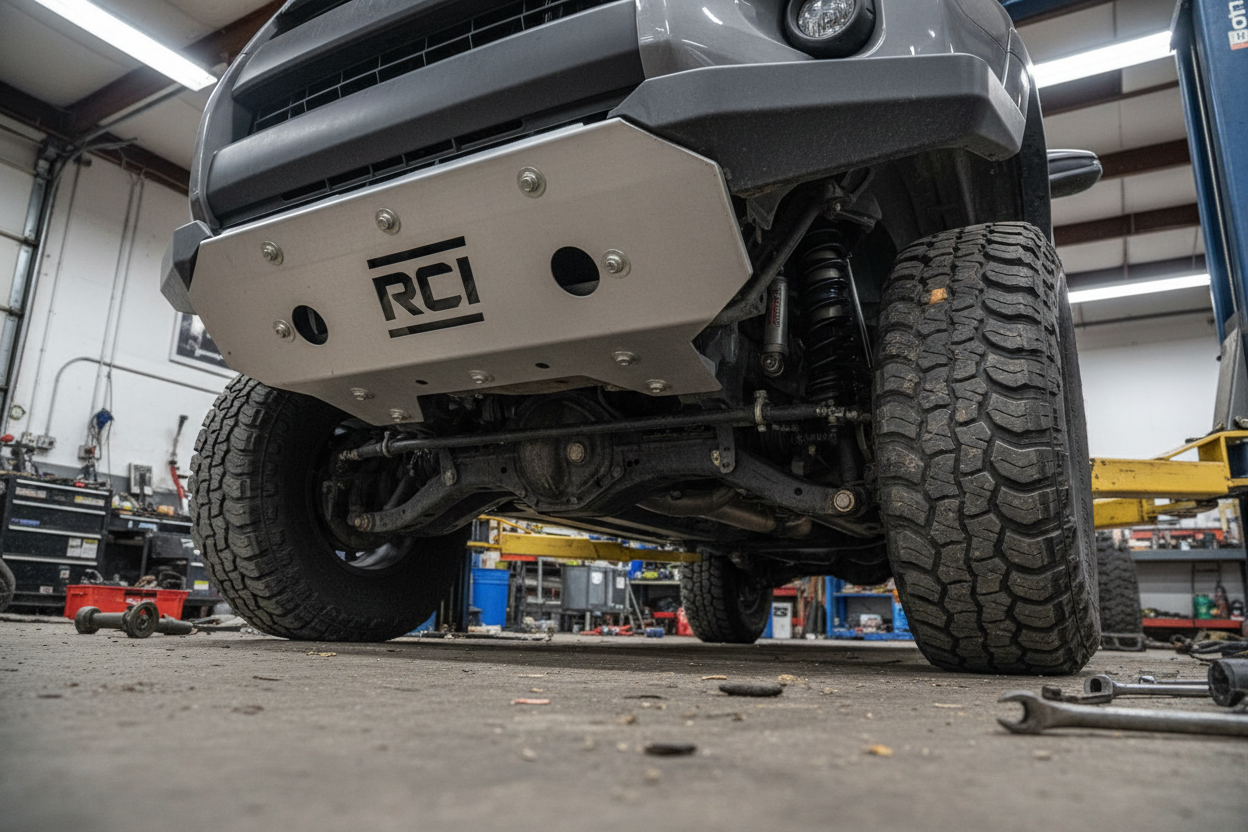
Skid plates aren't cosmetic — they're the only thing standing between your 4Runner's most expensive components and the terrain underneath them. This guide breaks down exactly what to protect, what it costs, and which RCI Offroad skid plates fit your 4th/5th Gen 4Runner.
Does a 4Runner Need a Skid Plate?
Short answer: if you off-road, wheel down rutted fire roads, or regularly deal with deep snow and ice ruts, yes. The factory plastic covers on a stock 4Runner are splash guards, not armor.
The parts most at risk on a 4th/5th Gen (2010–2024) 4Runner:
- Oil pan and engine block — the lowest point on most trims, first to hit on a rock ledge or high-centered obstacle.
- Front A-arms / control arms — exposed suspension components that take repeated hits on washboard and rock crawling.
- Catalytic converter — expensive to replace and a common theft target when unprotected and easy to access from below.
- Fuel tank — a puncture here isn't an inconvenience, it's a trip-ending (and potentially dangerous) failure.
Is a Skid Plate Really Necessary, or Is It Overkill?
For daily-driver-only 4Runners that never leave pavement, skid plates are optional. The moment you add trail use, overlanding, or even long gravel-road tows to your routine, they stop being optional and start being cheap insurance. An engine skid plate costs a few hundred dollars; a cracked oil pan or a holed fuel tank costs a tow, a repair bill, and a ruined trip.
Aluminum vs. Steel: Which Should You Choose?
Aluminum skid plates (like RCI Offroad's line) are lighter — meaningful if you're already carrying a roof rack, bumpers, and recovery gear — while still handling direct rock strikes well thanks to thick-gauge construction. Steel plates are marginally tougher against the worst repeated abuse but add unsprung weight and are more prone to rust over time. For most 4Runner builds, aluminum is the better trade-off between protection and payload.
Top 4Runner Skid Plates Compared (2010–2024)
Here's how RCI Offroad's 4Runner underbody protection lineup breaks down by what it covers:
| Skid Plate | Protects | Material | Best For |
|---|---|---|---|
| RCI Offroad Engine Skid Plate | Oil pan, engine block, front differential | Aluminum | The #1 priority — every trail-driven 4Runner |
| RCI Offroad A-Arm Skid Plates | Front A-arms / control arms | Aluminum | Rock crawling, KDSS-equipped trims |
| RCI Offroad Catalytic Converter Guard | Catalytic converter, transmission | Aluminum | Theft deterrence + underbody impact |
| RCI Offroad Bumper Filler Plate | Gap between front bumper and engine skid | Aluminum, CNC-cut | Finishing off a full front skid setup |
The Fix: RCI Offroad's Full-Underbody Kit
Rather than piecing together parts from three different brands with three different fitments, RCI Offroad builds a matched system for the 2010–2024 4Runner — every plate is designed to work together, so there are no gaps for a rock or root to sneak through.
RCI Offroad Engine Skid Plate — $349
This is the plate to start with. It sits under the oil pan and front differential — the single most-hit spot on a 4Runner in rutted terrain — and is available in KDSS and non-KDSS versions to match your trim's suspension.
RCI Offroad Engine Skid Plate | Toyota 4Runner (2010-2024)
RCI Offroad A-Arm Skid Plates — $224
A pair of CNC-formed plates that shield the front A-arms from the same rock strikes that damage the engine skid. If you're running KDSS, confirm the KDSS-specific version when ordering.
RCI Offroad A-Arm Skid Plates | Toyota 4Runner (2010-2024)
RCI Offroad Catalytic Converter Guard — $152
Covers both the transmission and catalytic converter in one plate — protection from underbody impacts and a deterrent against the catalytic converter theft wave that's hit SUVs nationwide.
RCI Offroad Catalytic Converter Guard | Toyota 4Runner (2003-2023)
RCI Offroad Bumper Filler Plate — $92.65
Closes the gap between your front bumper and the engine skid plate for a seamless, factory-look fit — plus a bit of extra radiator protection up front.
RCI Offroad Bumper Filler Plate | Toyota 4Runner (2010-2024)
Installation: Difficulty, Time, and Tools
Most RCI Offroad 4Runner skid plates bolt to existing factory mounting points — no drilling, no cutting. Budget:
- Difficulty: Beginner to intermediate
- Time: 1–3 hours per plate with hand tools (more if installing the full set in one session)
- Tools: Socket set, torque wrench, a floor jack or lift to access the underbody
Full step-by-step instructions are on each product's Installation tab.
Frequently Asked Questions
Are skid plates easy to install?
Yes for most 4Runner applications — RCI Offroad's plates bolt to factory mounting points, so a competent DIYer with basic hand tools can install a full set in an afternoon.
Will skid plates void my warranty?
Bolt-on skid plates that don't require drilling or modifying factory components generally don't void your Toyota warranty. If a dealer denies a claim, the Magnuson-Moss Warranty Act requires them to prove the aftermarket part caused the specific failure.
Do skid plates make a vehicle heavier?
Yes, but aluminum plates add relatively little weight — typically a few pounds per plate — especially compared to the weight of steel alternatives or a full bumper/armor package.
Do skid plates cause rust?
Aluminum skid plates don't rust. Steel plates can, over time, if the coating is scratched and moisture sits against bare metal — another reason aluminum is the lower-maintenance choice.
How much do skid plates typically cost?
For the 4Runner, individual plates from RCI Offroad range from roughly $90 (bumper filler) to $350 (engine skid), with a full front-to-back setup landing in the $800–$900 range.
Can you off-road without skid plates?
You can, but every rock strike is a gamble on your oil pan, fuel tank, or catalytic converter. For anything beyond mild gravel roads, skid plates are the cheapest insurance policy you can bolt to your truck.
Final Word
If you only protect one thing, make it the engine skid plate — it covers the most commonly hit, most expensive-to-repair part of the truck. From there, build out to A-arm and catalytic converter protection as your trail use grows. Your 4Runner (and your wallet) will thank you the next time a rock ledge gets in the way.
Ready to armor up your 4Runner? Get the RCI Offroad Engine Skid Plate | Toyota 4Runner (2010-2024) to solve your #1 underbody vulnerability, or browse the full 4Runner Skid Plates collection to build a complete protection package.